Leonardo painted Cecilia Gallerani turning her head as the ermine in her arms looks in the same direction. This portrait inspired Gabriel Wyatt to create Ermine, the companion you can visit at the reading-room desk.
Czartoryski Museum · National Museum in Kraków · MNK XII-209. Artwork and photographic reproduction: public domain.
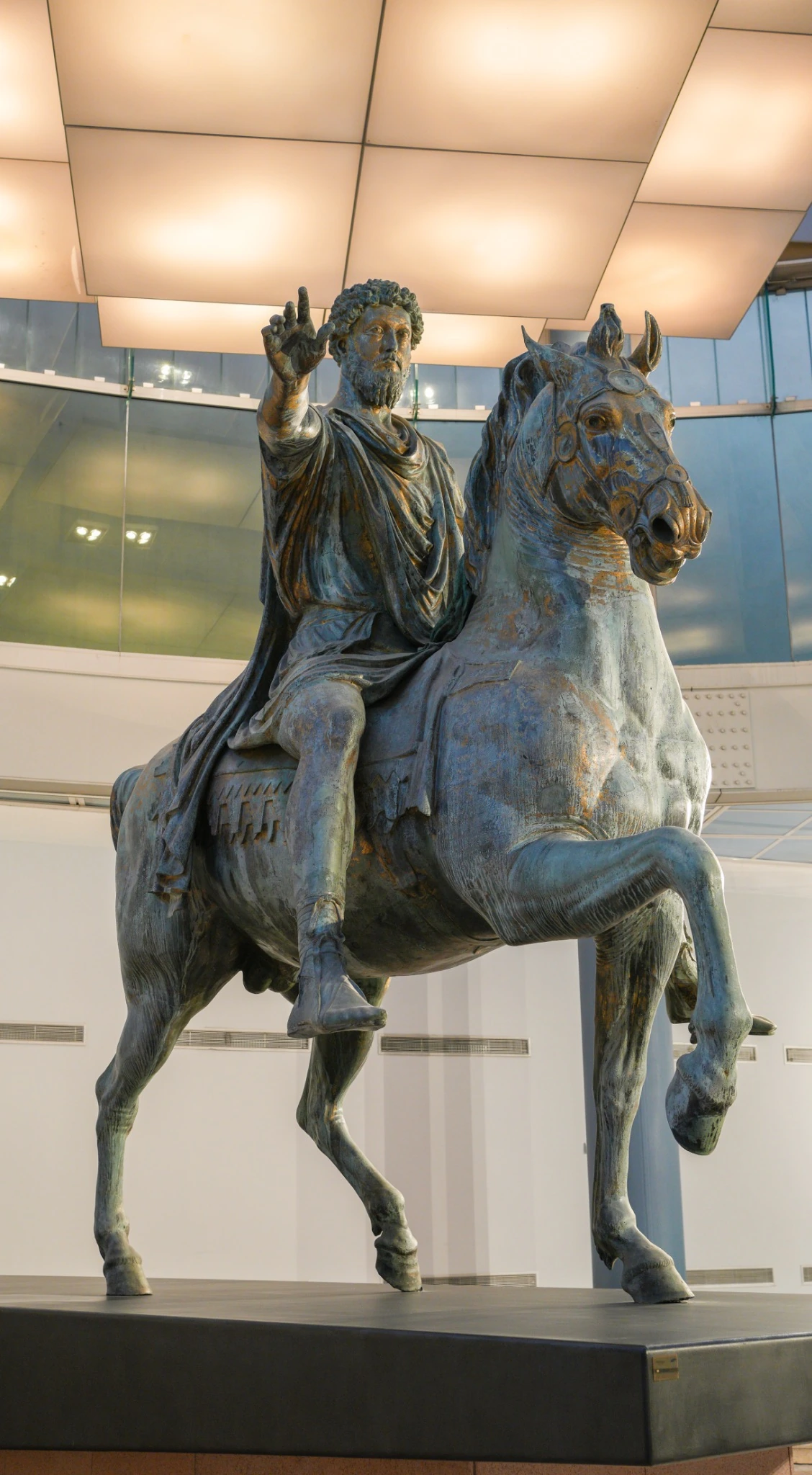
Equestrian Statue of Marcus Aurelius
Roman bronze · 161–180 CE · Capitoline Museums, Rome
Marcus Aurelius raises his right hand while his horse lifts one foreleg. The original bronze stands in the Marcus Aurelius Exedra. The museum records it as MC3247.
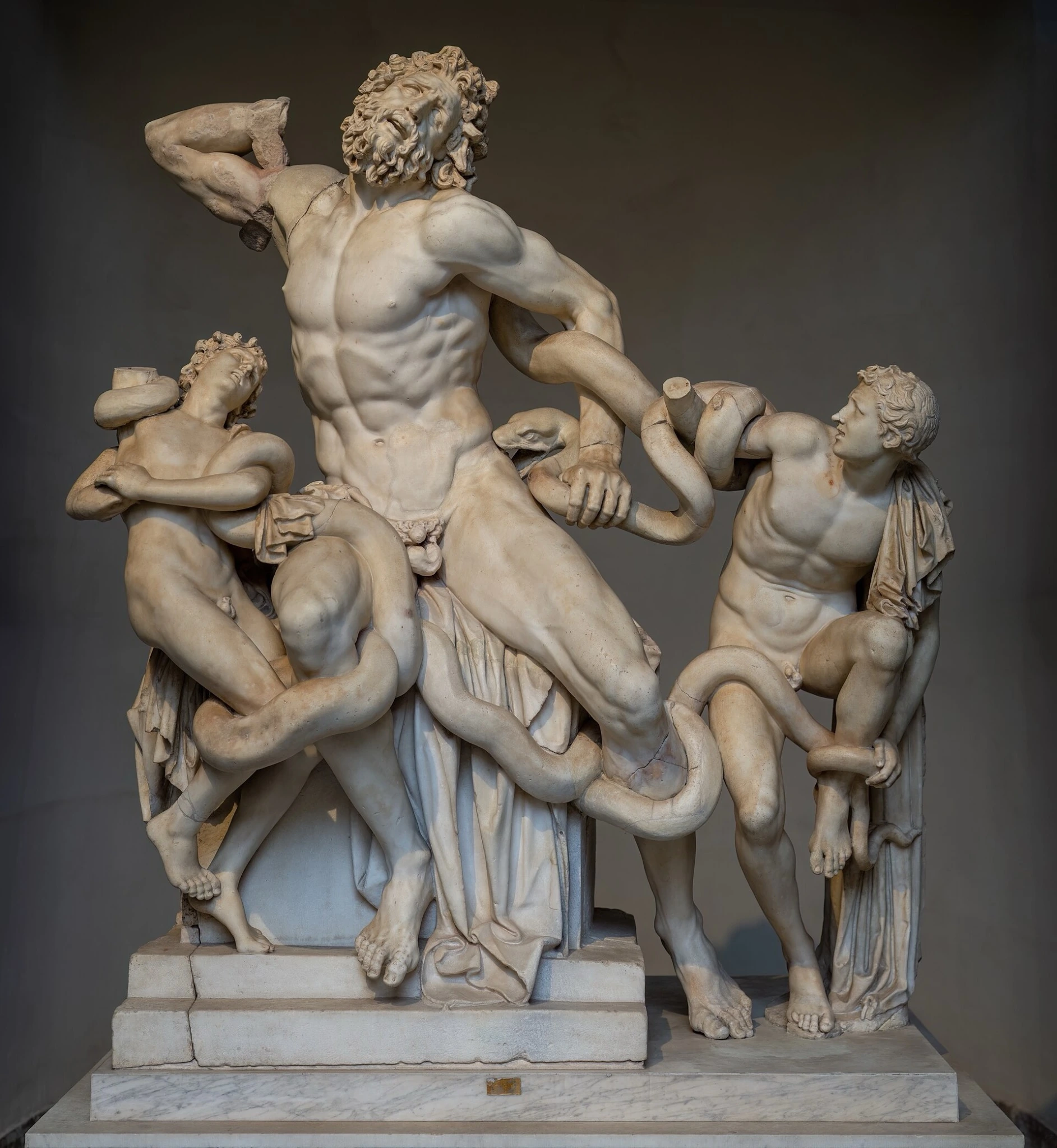
Marble · c. 40–30 BCE, per the Vatican Museums · Octagonal Court
The marble group represents the Trojan priest Laocoön and his two sons. It was uncovered on Rome’s Esquiline Hill in 1506 and is displayed at the Vatican Museums’ Pio Clementino Museum.
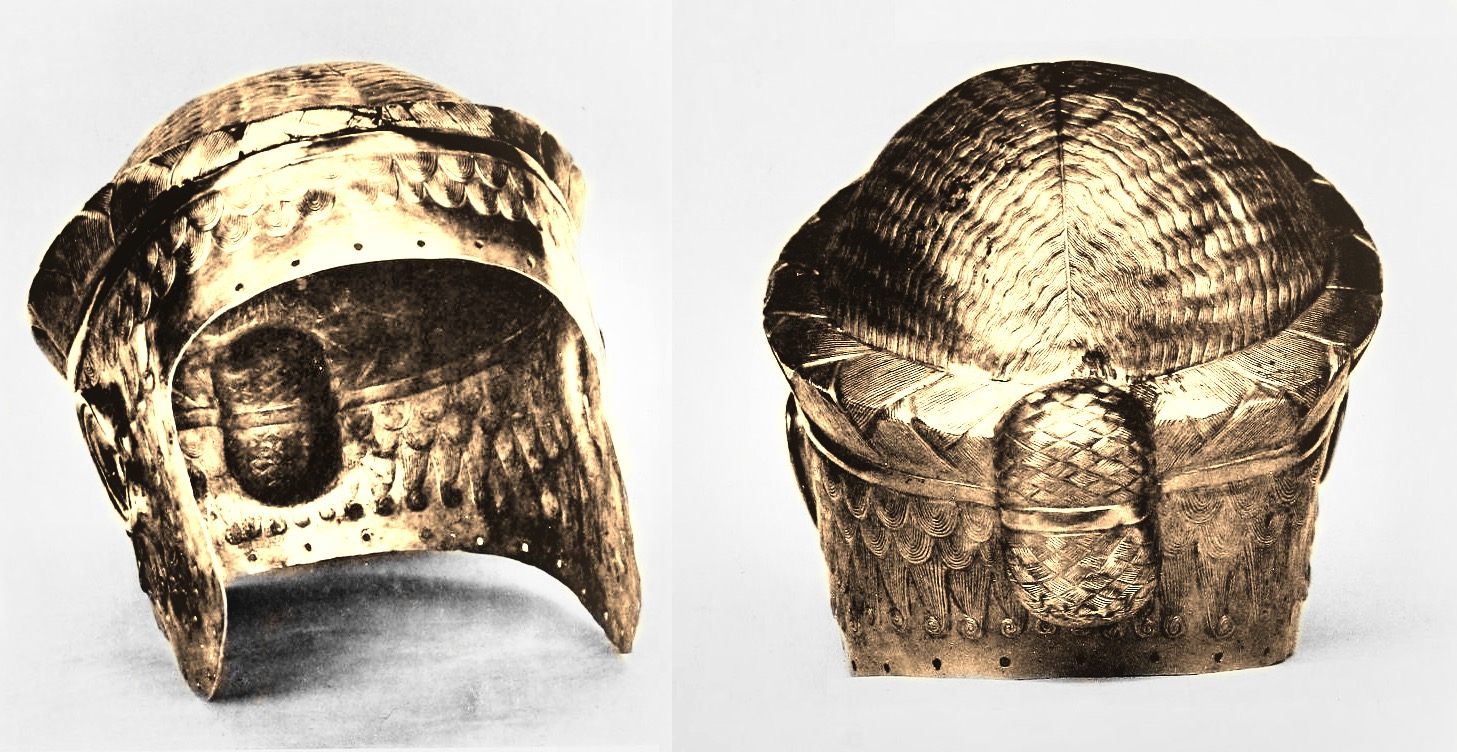
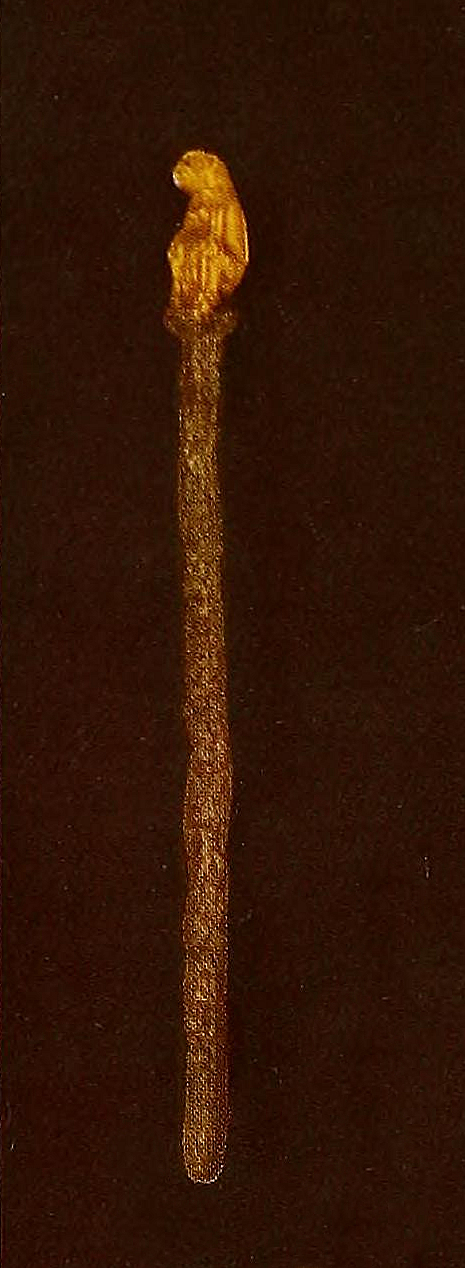
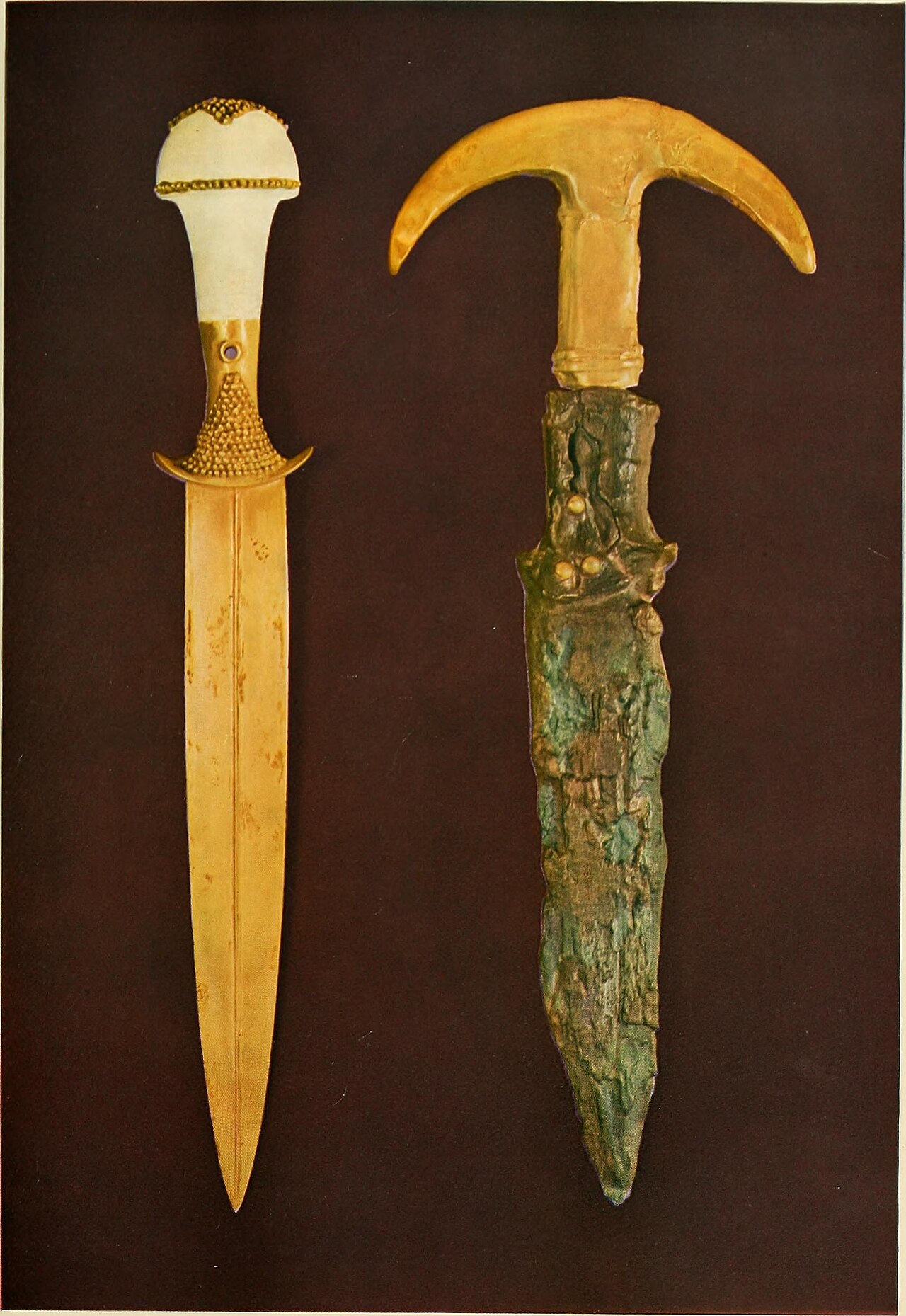
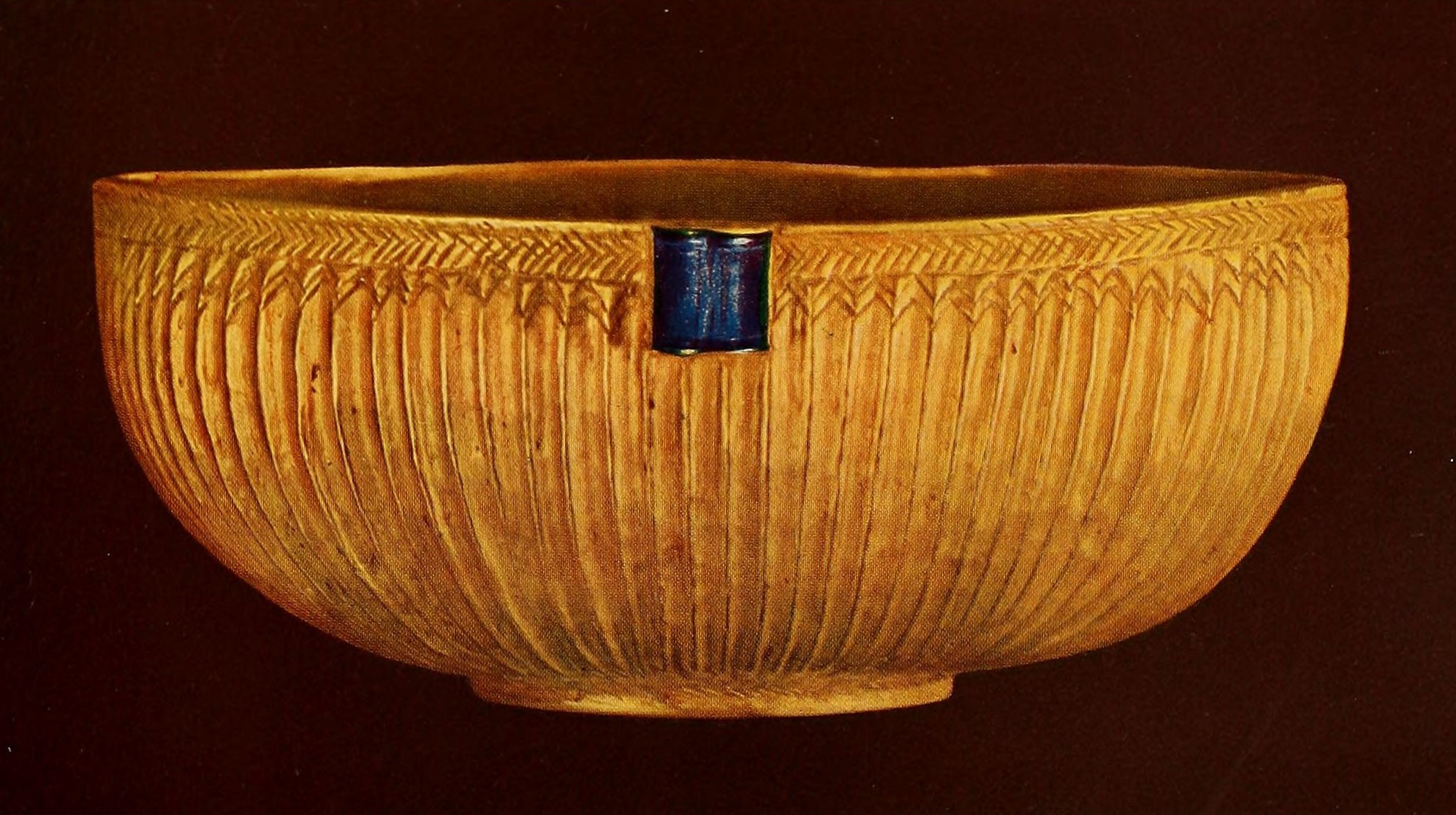
Objects from grave PG 755 in the Royal Cemetery at Ur. Examine the expedition photographs to compare the modeled hair of the helmet, the small animal figure, the paired daggers, and the fluted bowl.
Golden Helmet of Meskalamdug
Sumer · Royal Cemetery at Ur · c. 2600 BCE
The left view looks into the face opening. In the rear view, finely rippled locks divide at the crown and meet a broad band above a woven-looking knot. A row of small holes follows the lower edge.
Joint Expedition of the British Museum and the University of Pennsylvania to Mesopotamia · Photograph and credits
Gold monkey on a rod
A small seated monkey crowns the long shaft. Zoom into the upper end to see the outline of its face, the bent limbs, and the contrast between the figure and the slender rod.
Joint Expedition of the British Museum and the University of Pennsylvania to Mesopotamia · Image record
Two daggers from Ur
The excavation plate keeps both objects side by side. At left, rows of small gold studs meet a pale rounded grip. At right, the broad curved pommel stands above a dark, weathered surface.
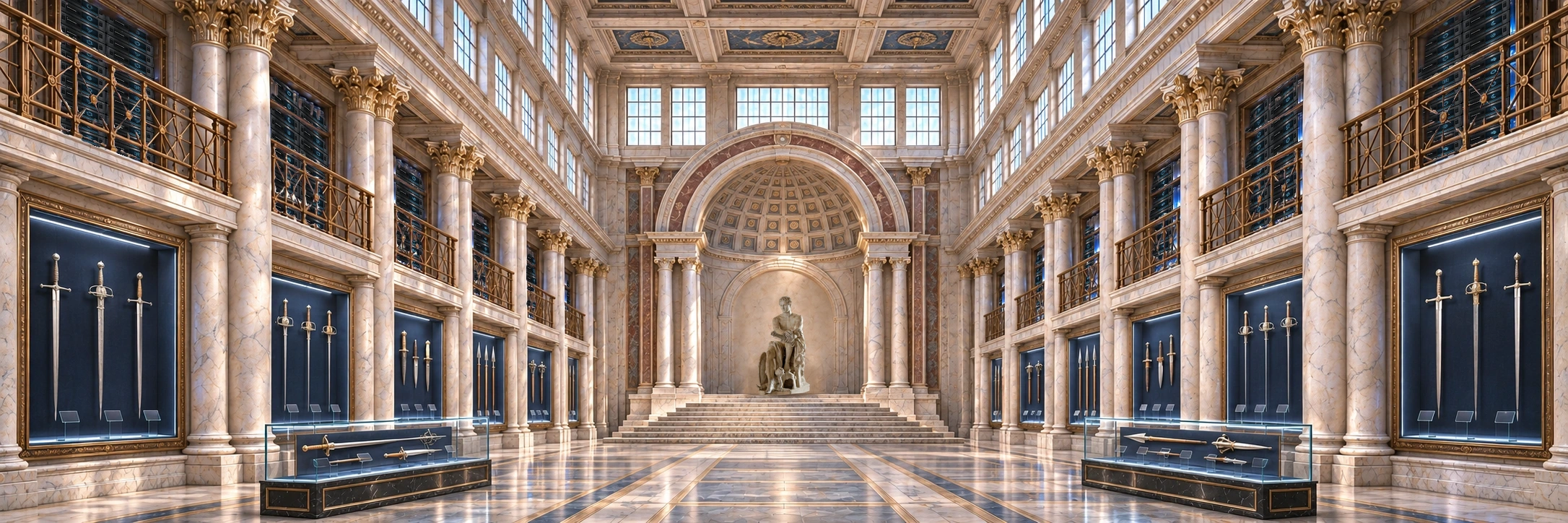
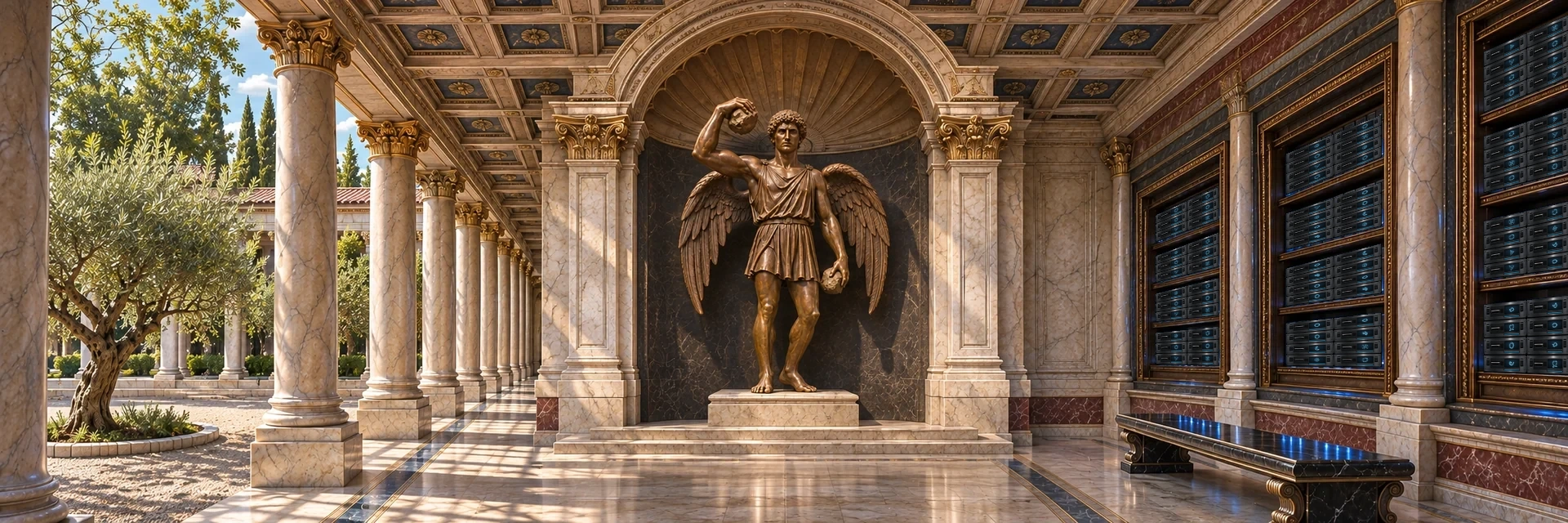
Select Ares to examine the statue, or select a marked case to compare a museum example.Inspect the Armory hall
Armory portico · Sculpture
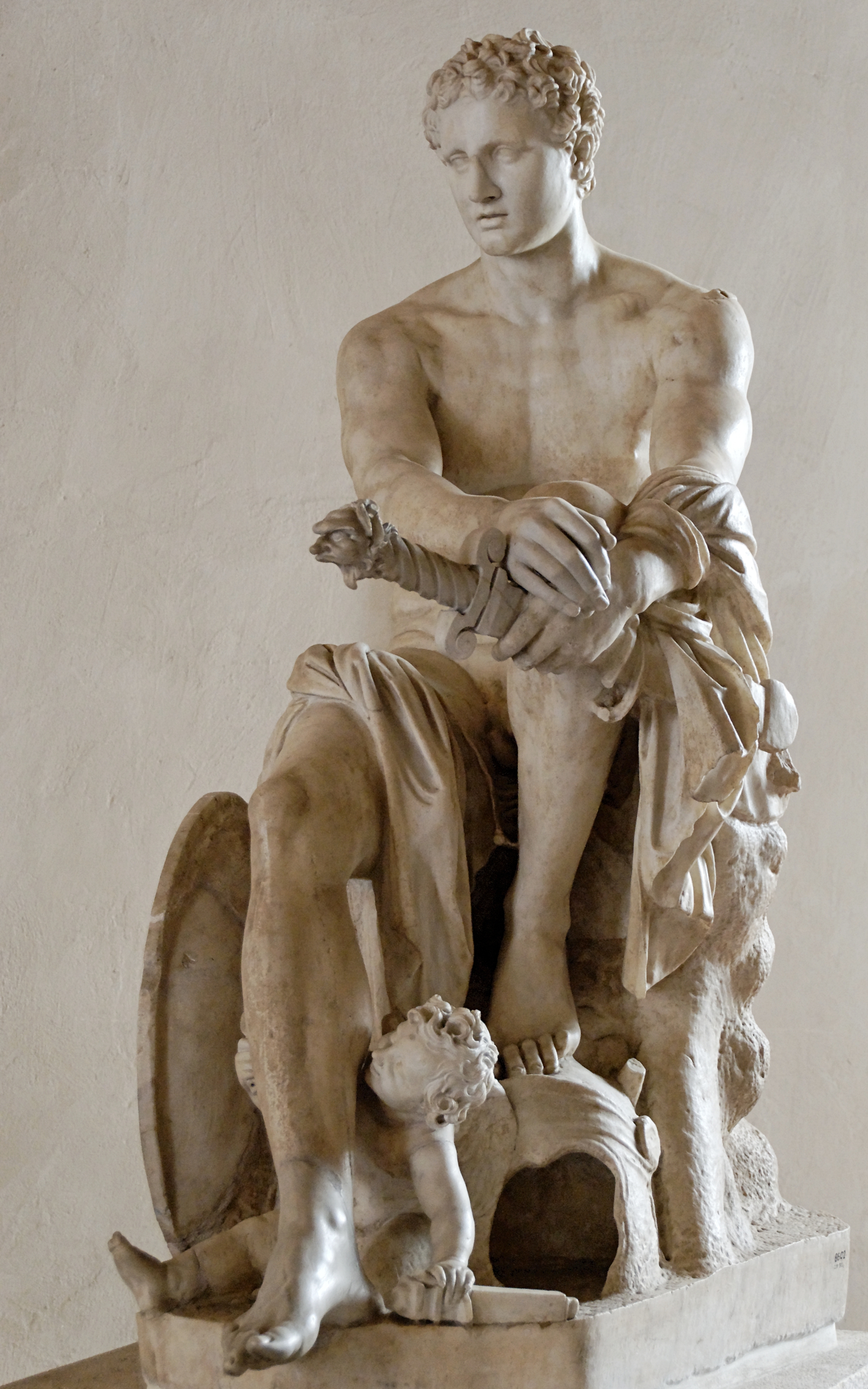
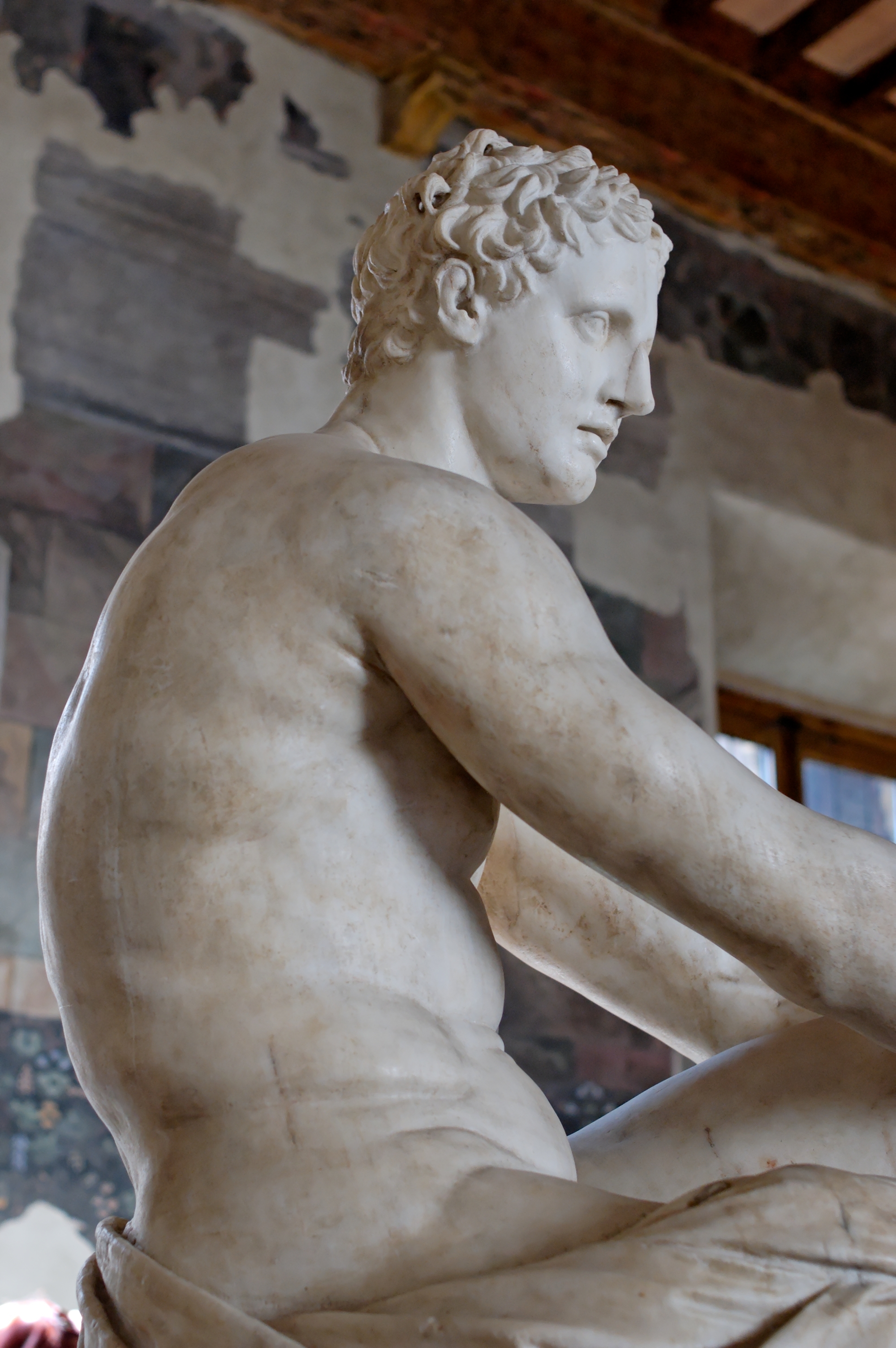
Ludovisi Ares
Ancient Roman marble statue Museo Nazionale Romano, Palazzo Altemps, Rome · Inv. 8602
Ares rests both hands over his raised knee. The turn of his head is easiest to see in profile. Look down toward his feet for Eros, a much smaller figure carved against the seated god.
The original belongs to the Boncompagni Ludovisi collection in Rome. The Library portico shows a digital installation. The Warburg Institute dates the statue to 138–161 CE and records Gian Lorenzo Bernini’s work on the sword hilt and the head of Eros in 1622.
Photographs by Marie-Lan Nguyen (Jastrow), released into the public domain. Full-length view photographed in September 2009. Profile photographed in September 2006. Full-length photograph · Profile photograph.
Explore historical objects by material, region, or museum. Open a display for its date, provenance, and accession number.
An ermine is a small, quick-footed weasel also known as a stoat. In cold climates, its brown coat can turn white for winter, while the tip of its tail stays black.
Ermine can help you find a title, author, or subject in the Library. Start with The Time Machine or Plato.
At your reading desk, Ermine keeps you company. In Correspondence, he can suggest wording and help you design your signature.
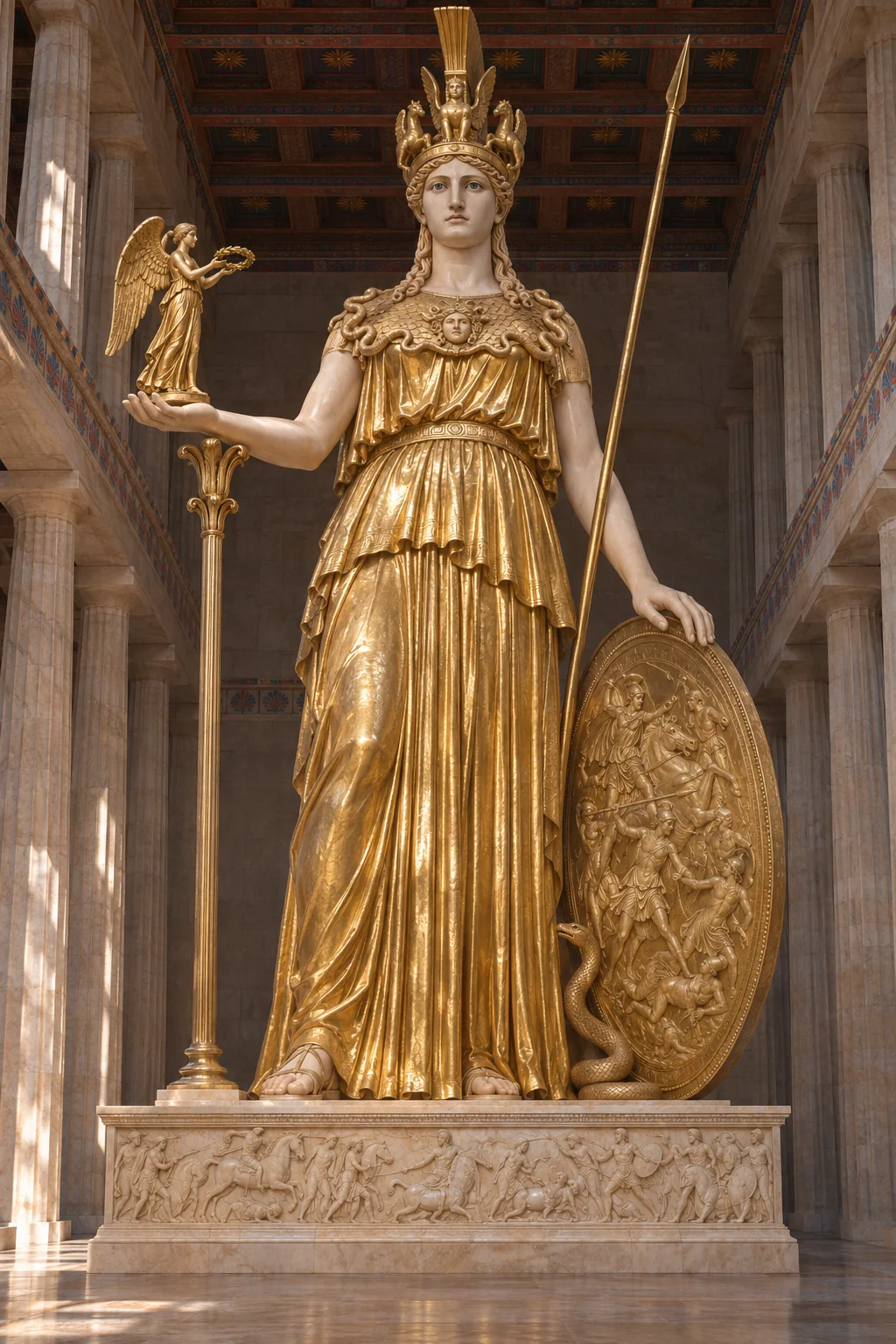
Pheidias made Athena Parthenos for the Parthenon in Athens. An inscribed account records the gold and ivory used in its construction.
A small Roman-period copy, the Lenormant Athena, preserves details of the shield and pedestal. The image shown here is a modern interpretation of the lost statue.
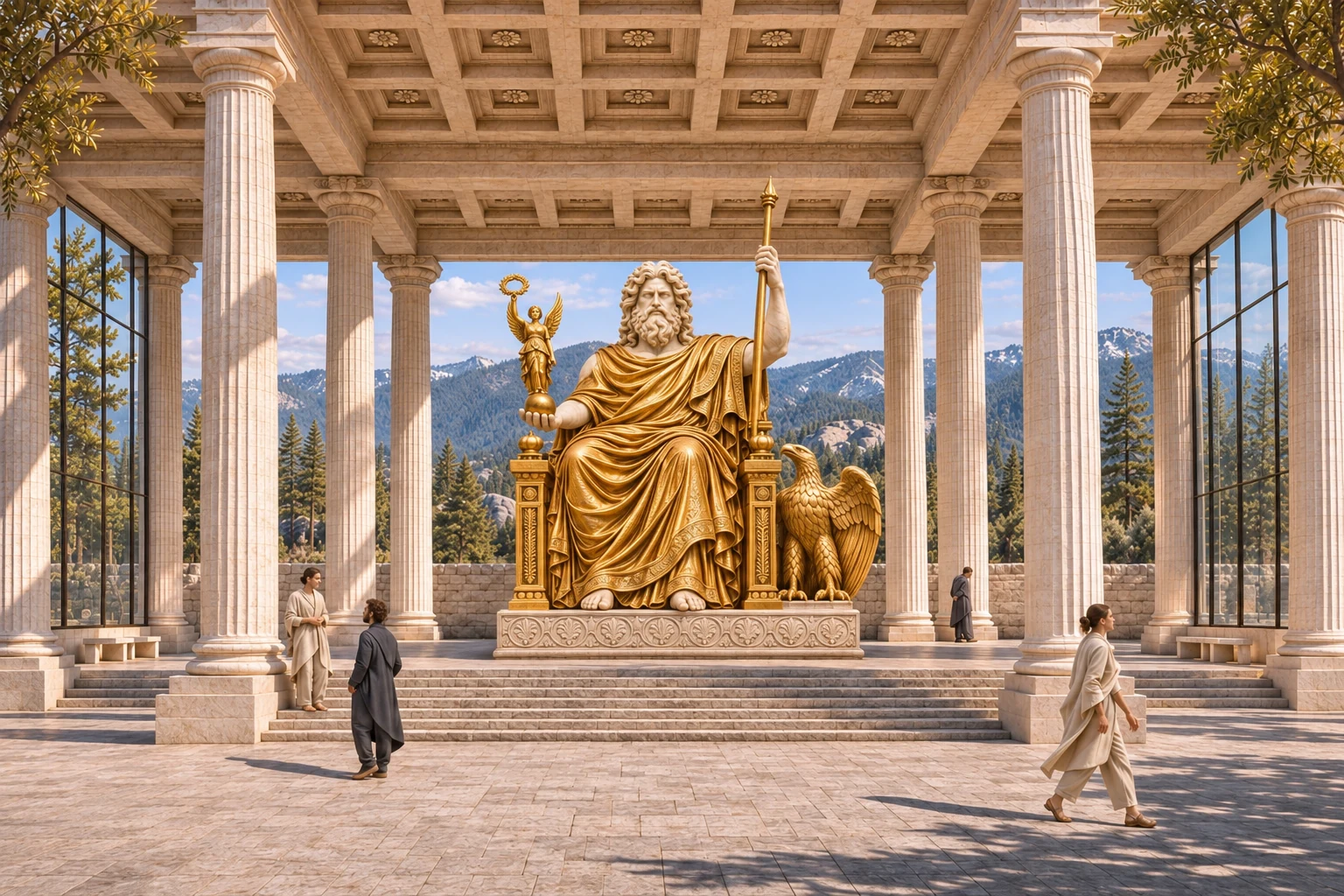
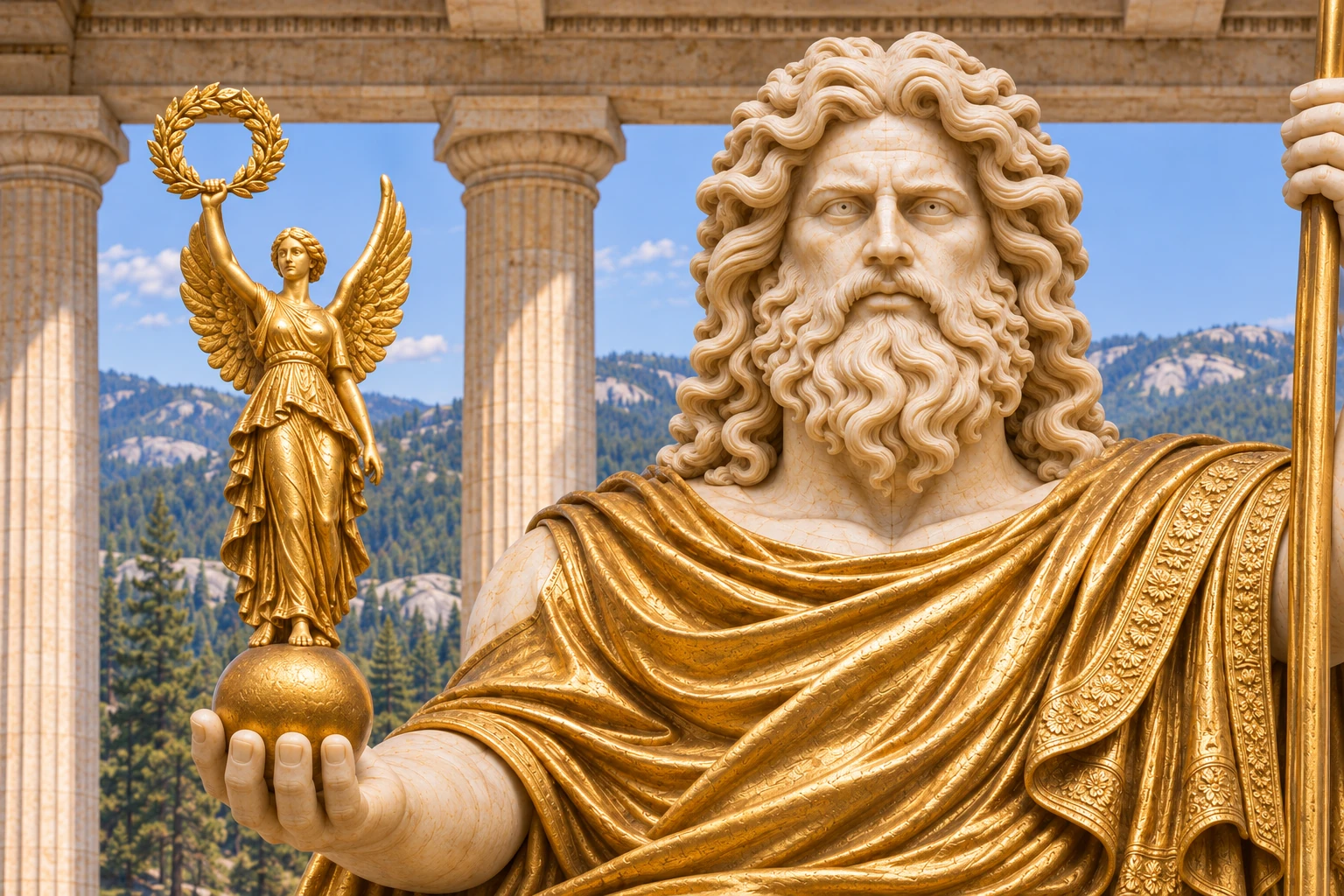
Pausanias describes Zeus seated at Olympia, holding Nike in his right hand and a sceptre in his left. The ancient statue was made of gold and ivory.
Here, Nike raises a wreath and an eagle stands beside the throne. The supplied reconstruction interprets the ancient account, which places the eagle on the sceptre.
Coins from Elis preserve the profile of Zeus with a full, curling beard. The individual locks are the sculptor’s interpretation in this modern study.
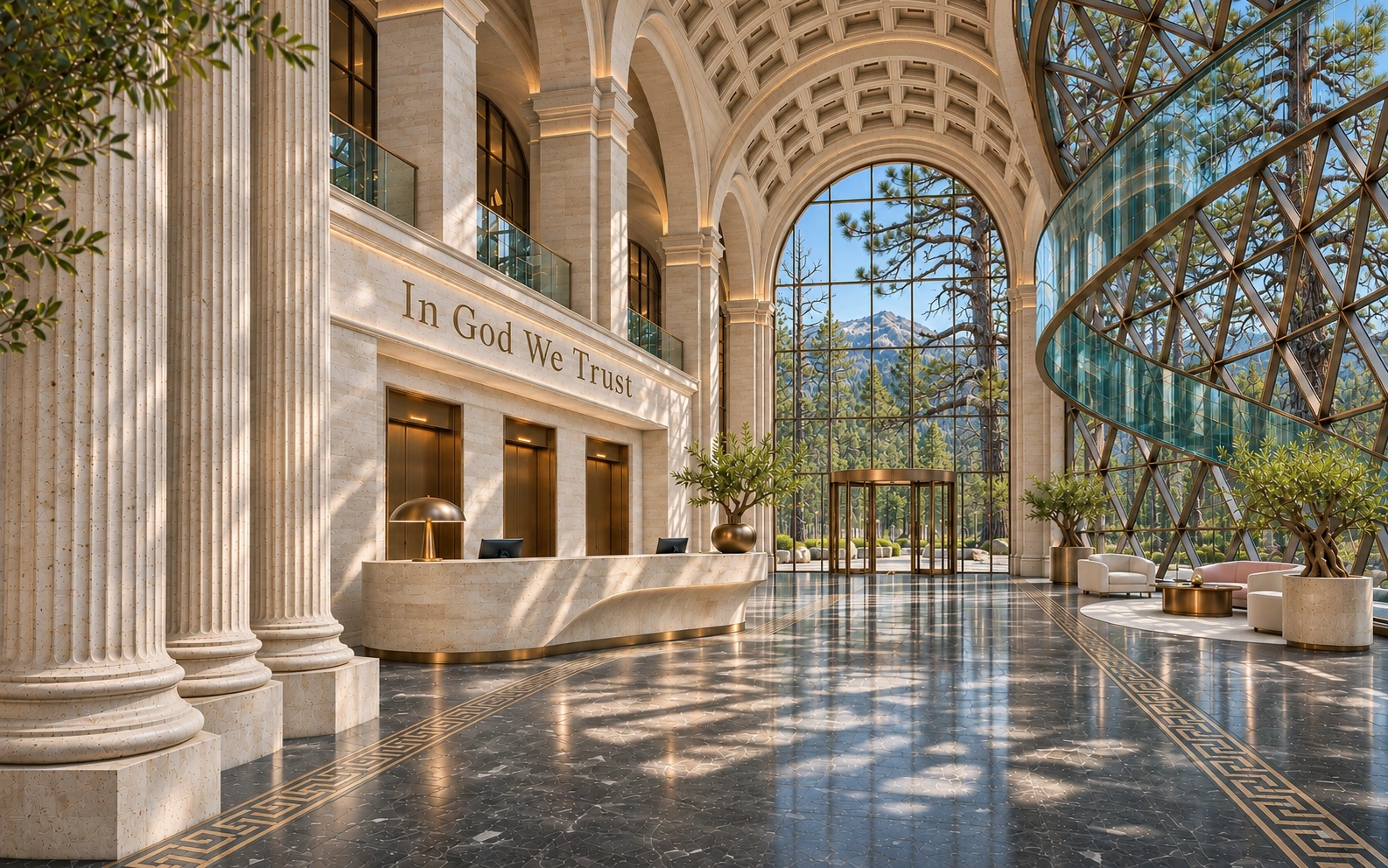
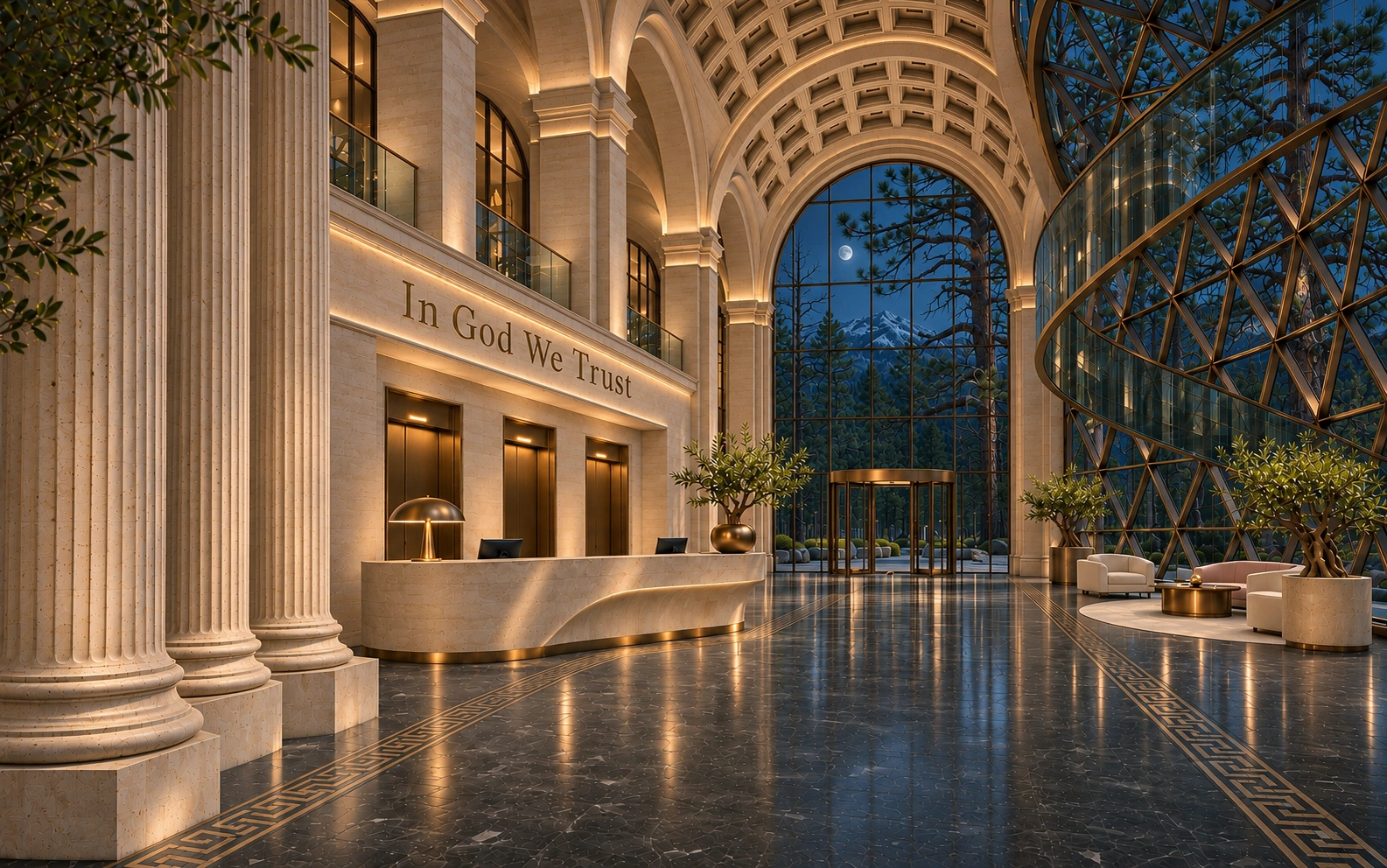
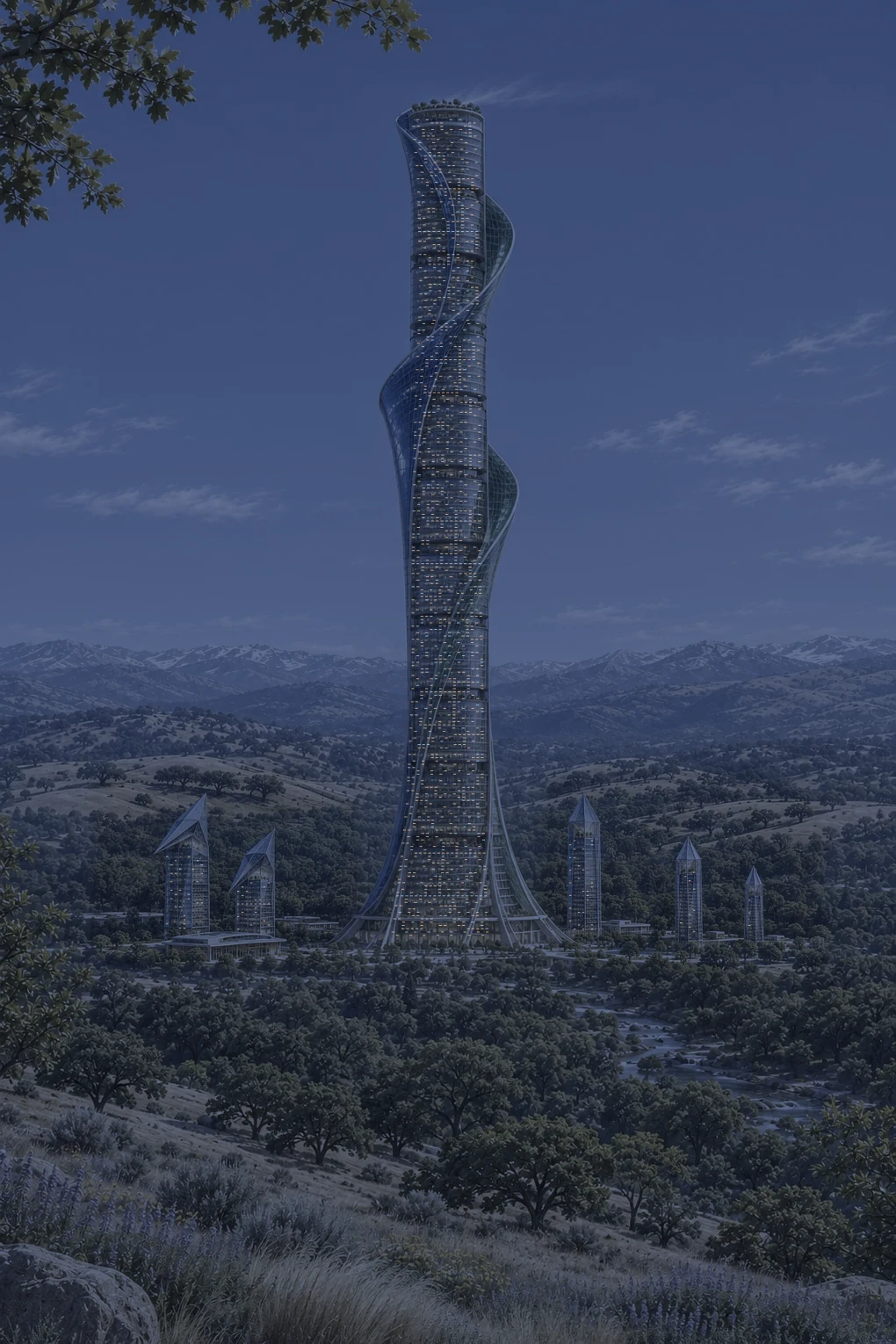
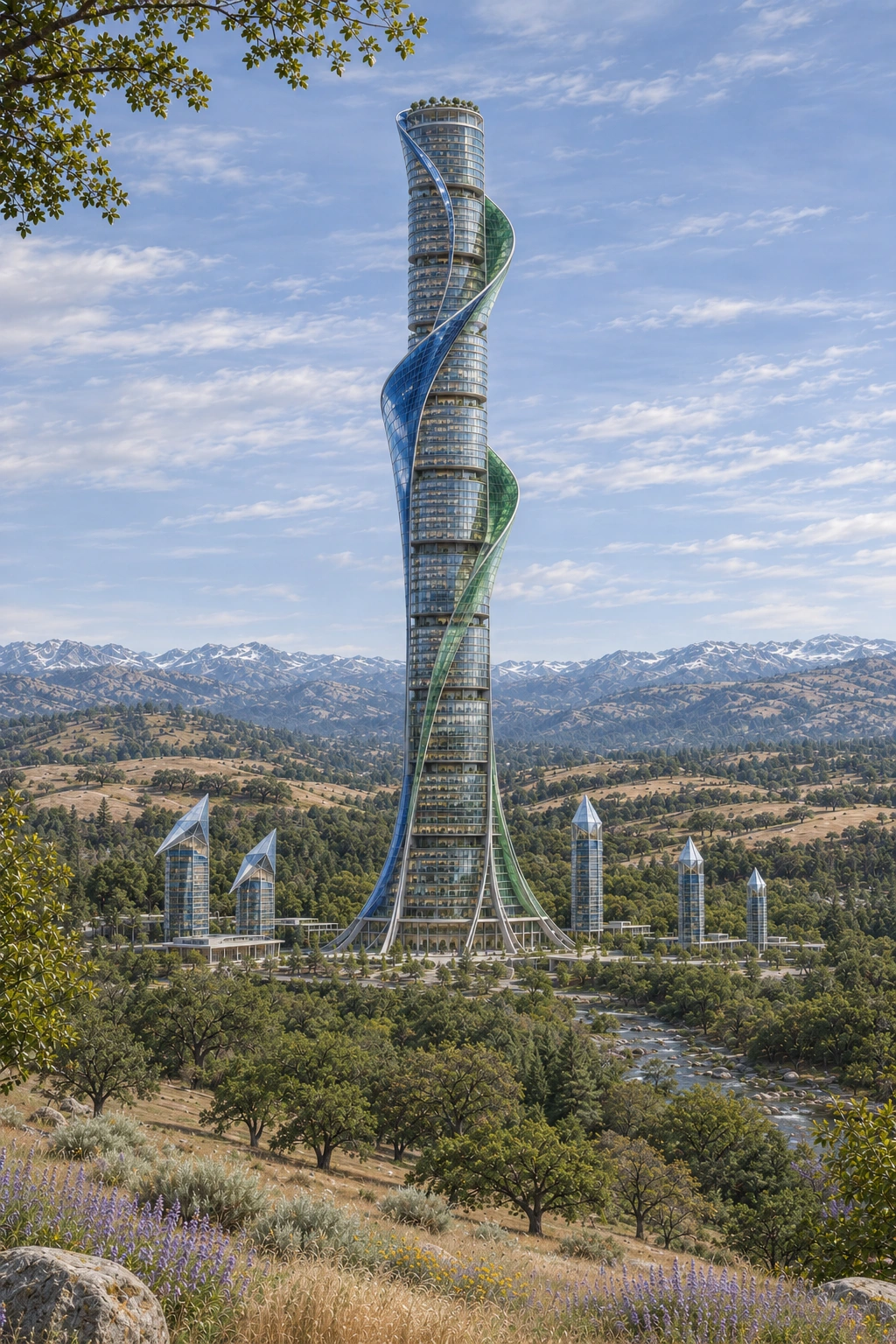
Enter Wyatt Tower through the lobby bearing the inscription “In God We Trust.” The side windows face the river. The bronze lift leads to the two-chair salon on floor 250.
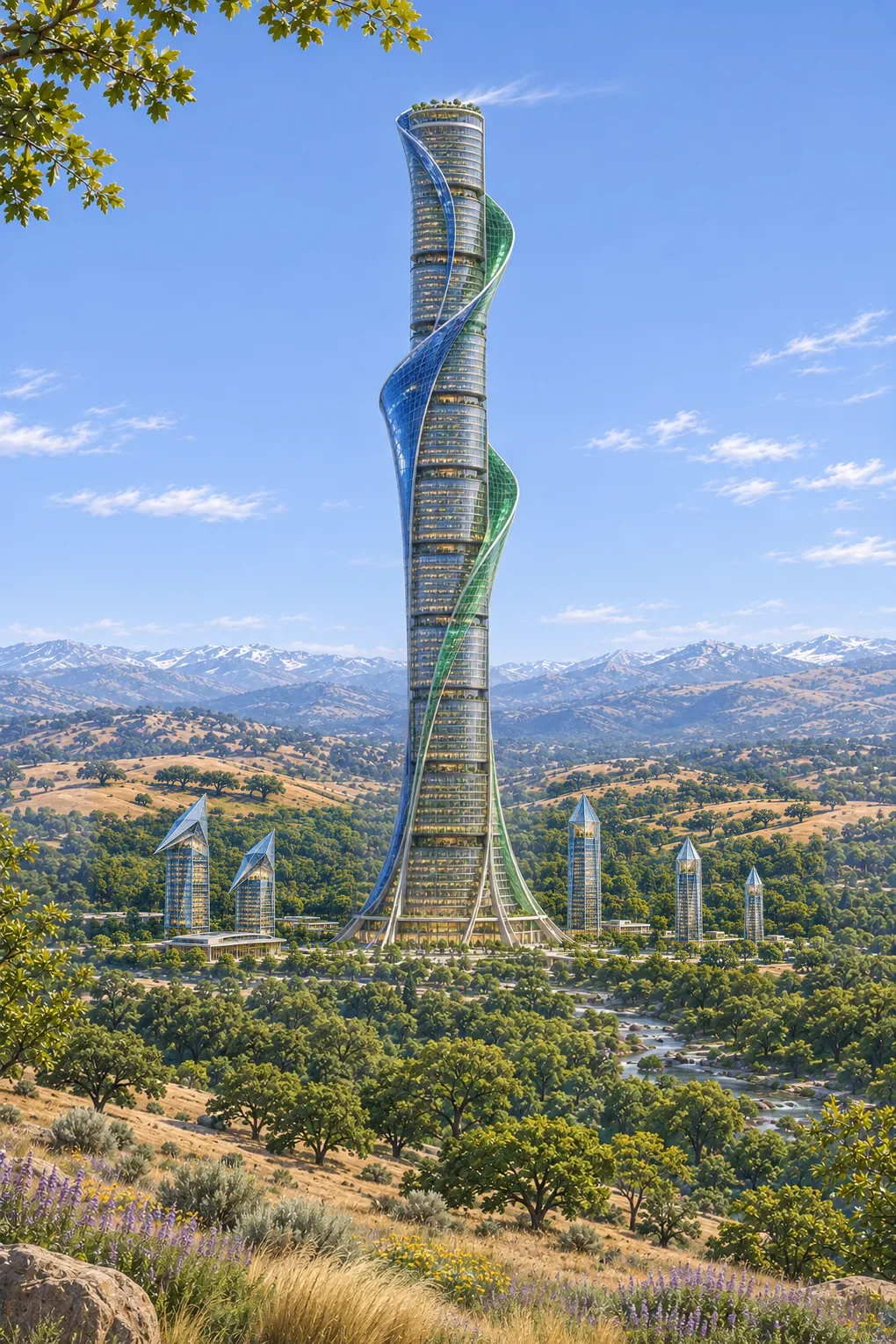
From the Library desk, the central tower is visible above the foothills. Its round floors sit behind glass. Above the reception entrance, blue and green bands spiral around the glass exterior of Wyatt Tower.
The three separate side-valley buildings are not Wyatt Tower. They follow the river from left to right. A projecting crown and broad base give the I its silhouette. Two curved glass wings meet at the heart’s central cleft. Farther up the wooded slope, four angled wings of steel and glass form the W.
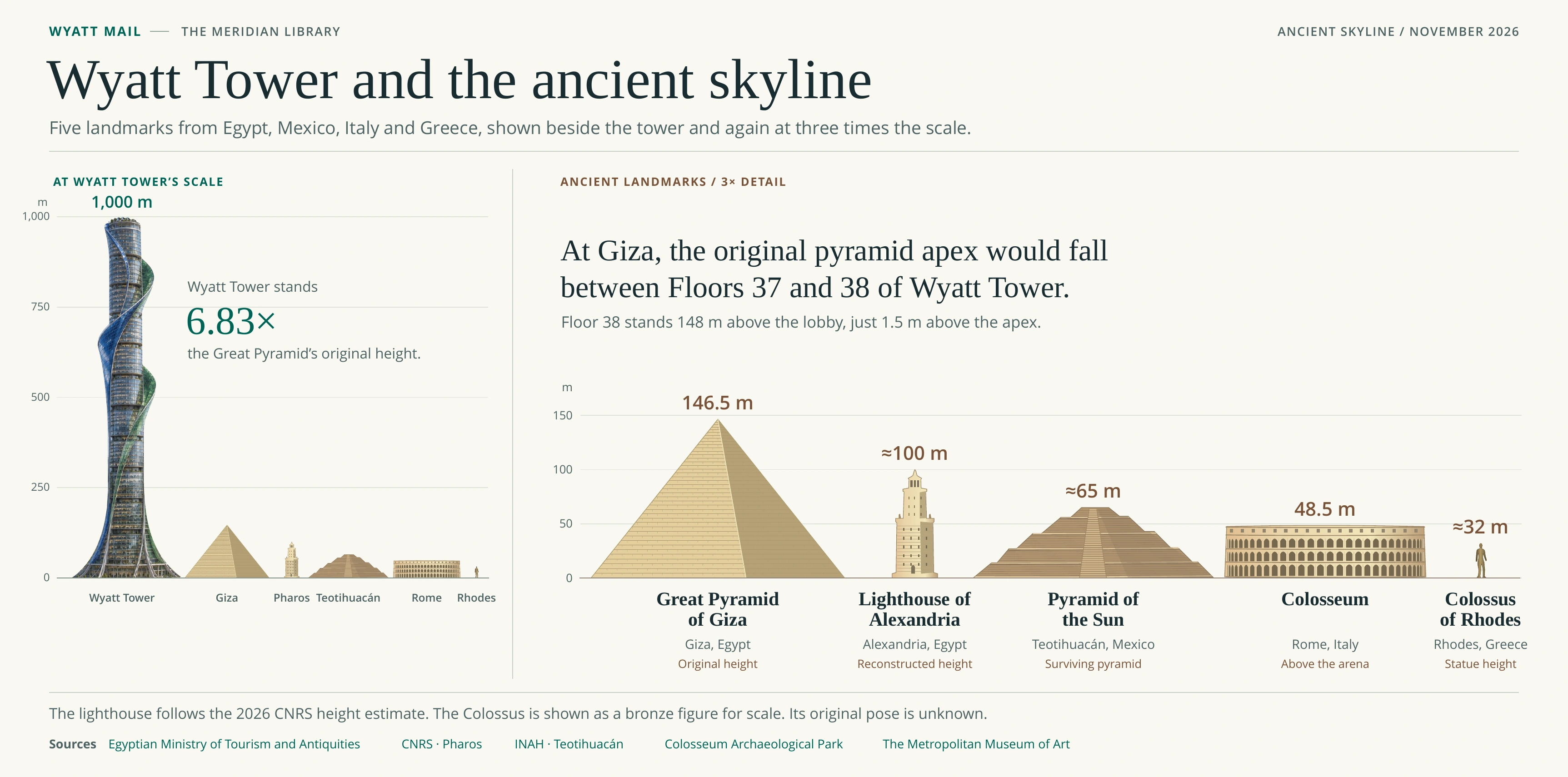
The modern comparison records architectural heights as of November 2026. Ancient heights include original and reconstructed estimates.
Modern skyline
Landmark
Height
Wyatt Tower (design)
1,000 m
Burj Khalifa
828 m
Merdeka 118
678.9 m
Shanghai Tower
632 m
Makkah Royal Clock Tower
601 m
Ping An Finance Center
599.1 m
Lotte World Tower
554.5 m
One World Trade Center
541.3 m
Guangzhou CTF Finance Centre
530 m
Tianjin CTF Finance Centre
530 m
CITIC Tower
527.7 m
Ancient skyline
Landmark
Height
Great Pyramid of Giza
146.5 m
Lighthouse of Alexandria
≈100 m
Pyramid of the Sun
≈65 m
Colosseum
48.5 m
Colossus of Rhodes
≈32 m
Reading room
From the reading-room window
Wyatt Tower
Look through the window to the right of the desk. Blue and green bands wind around Wyatt Tower above the valley. Enter its lobby and take the lift to the two reading chairs on floor 250.
The collection follows the current verified catalog manifest. Open a work to see its edition, language and source. The Dead Sea Scrolls records lead to the archives that hold them.
Light in the galleries
Clouds passing above the reading hall soften the sunlight on the marble. At night the moon casts a silver reflection between the tables. Clouds move across the wing windows, revealing stars through breaks in the cover.
About the reading hall
Open a text edition and select Read aloud to listen with a voice installed on your device. Listening starts at your current section.
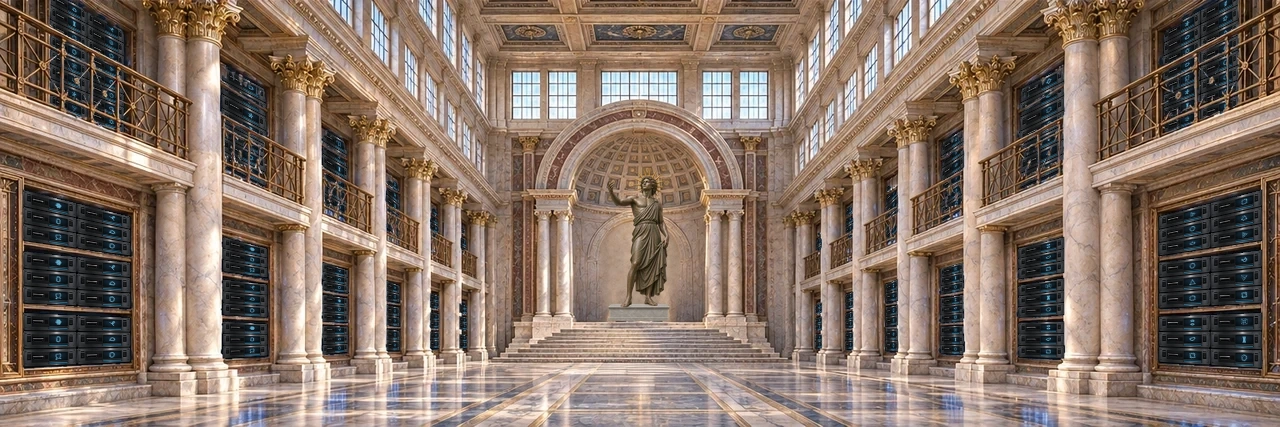
In the central recess, Moses sits on a marble pedestal. The figure that once stood in the ancient library is still a matter of debate. Scholars have suggested both Athena and Celsus. Historical study (PDF)
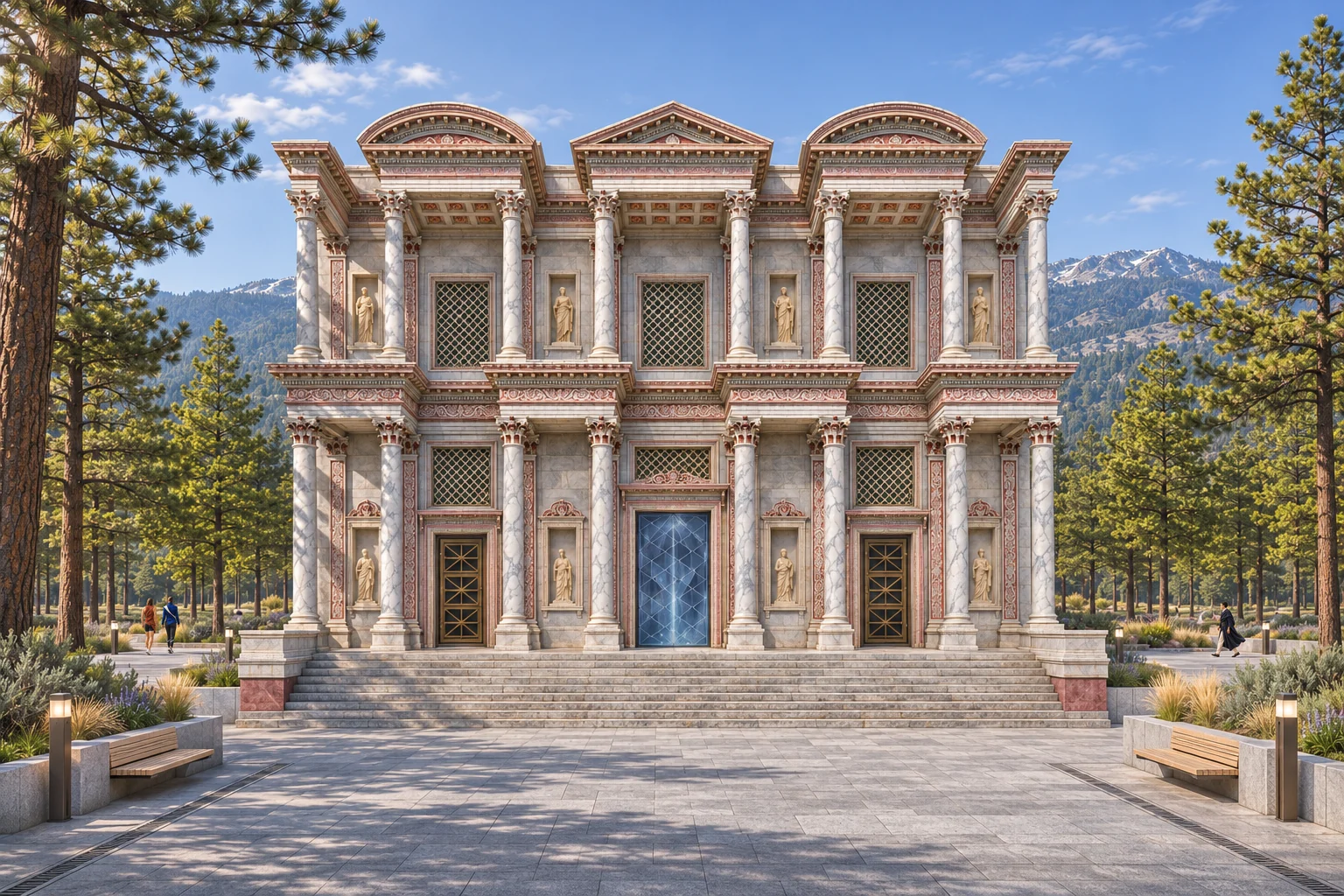
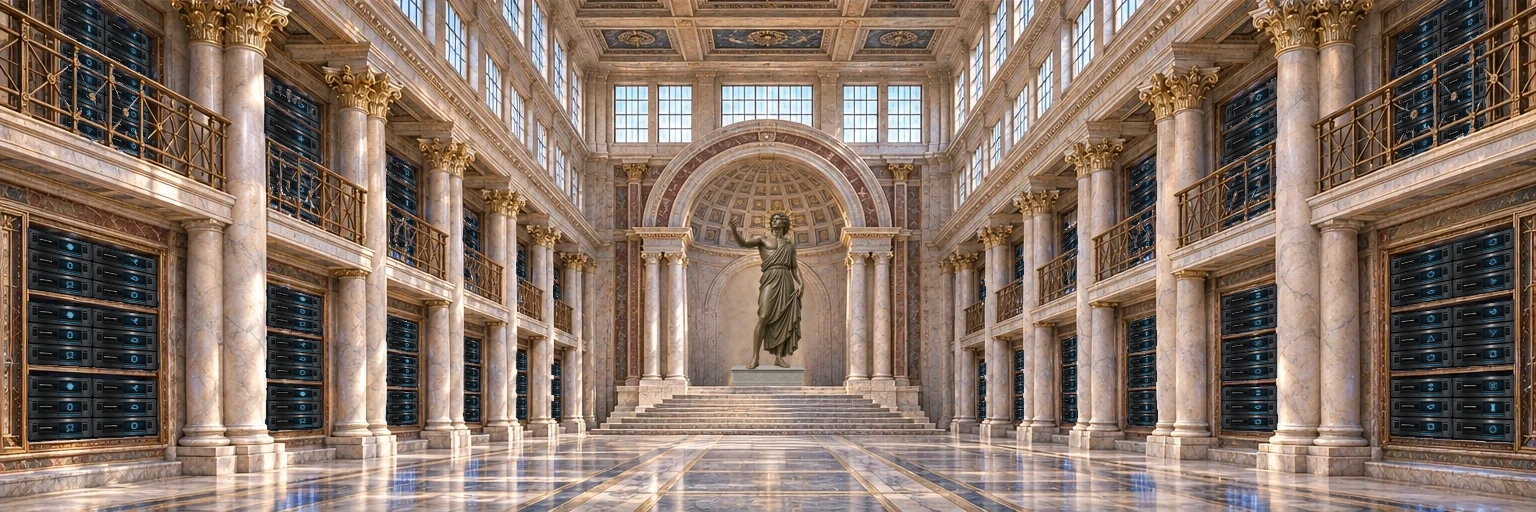
At Ephesus, readers entered one rectangular hall. Scroll cupboards occupied niches along three walls, and a semicircular apse opened opposite the entrance. In the Meridian Library, Moses occupies the apse and the shelves hold Actives. Read the architectural study (PDF)
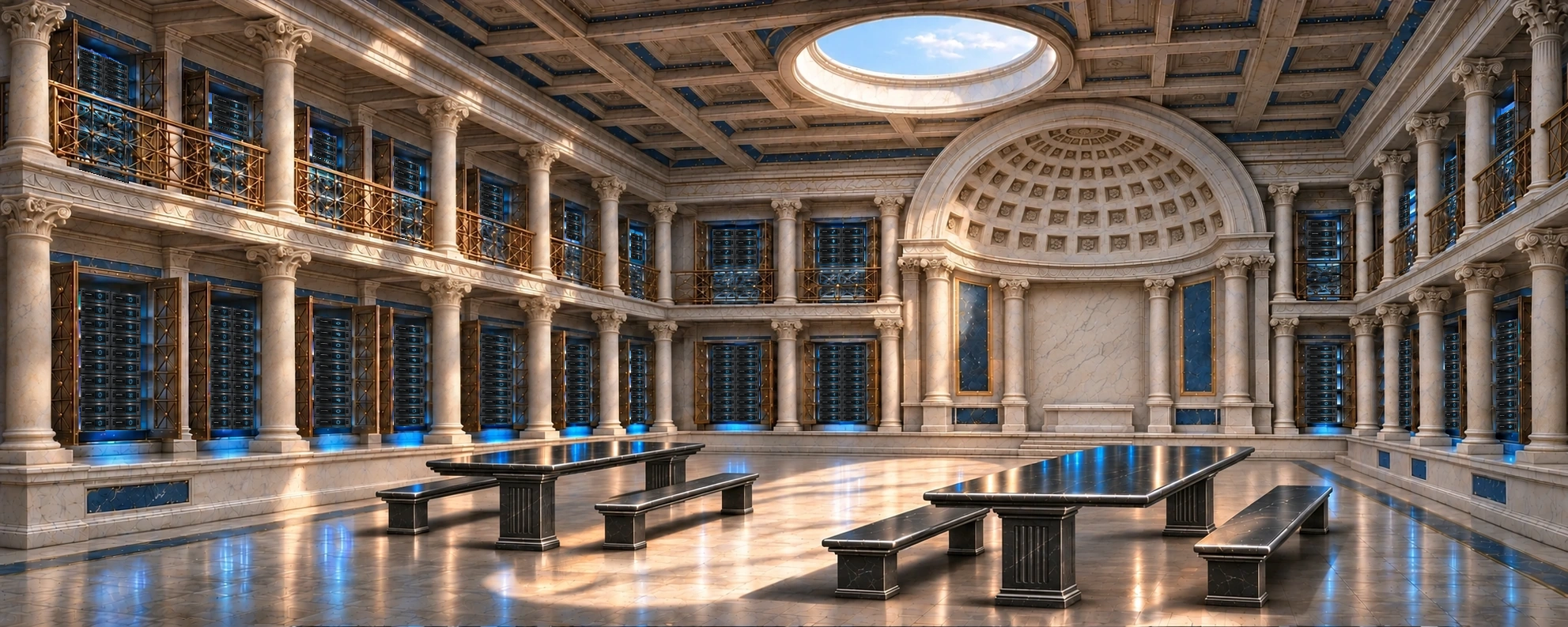
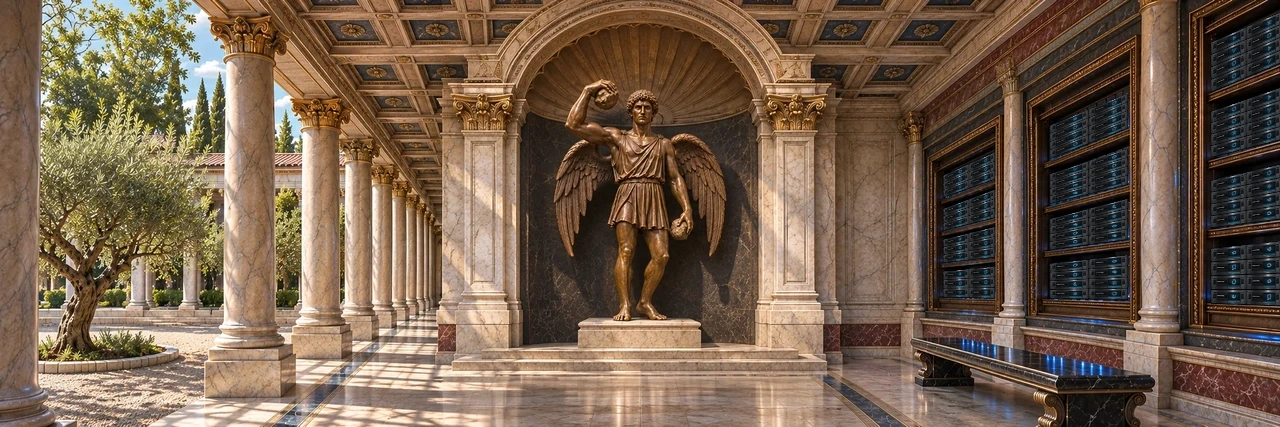
The black marble furniture is Wyatt Mail’s design. Each slab rests on two square, fluted marble piers with stepped bases. Low benches flank the polished slabs. The opening in the ceiling admits sunlight by day and moonlight at night.
The statues at the entrance
Arete, Hipparchia, Sosipatra, and Hypatia occupy the upper niches. Below them stand Socrates, Plato, Aristotle, and Marcus Aurelius. Wyatt Mail’s eight sculptures are modern interpretations. At Ephesus, the four figures on the façade personified wisdom, virtue, intellect, and knowledge. Read about the ancient façade
At the Roman Library of Celsus, nine steps led to three entrances. On the lower façade, four pairs of smooth marble columns rise from square plinths. Their capitals carry scrolls above carved acanthus leaves. Above the central opening was a triangular pediment, with curved pediments to either side. The columned galleries inside gave access to wall cupboards for scrolls. Austrian Archaeological Institute · Description of the façade
Ádám Németh’s reconstruction informed the exterior. Balage Balogh’s illustrated interior informed the furnishings. In Wyatt Mail’s reading hall, blue digital archives take the place of scrolls. The philosopher portraits, black marble tables, crystal doorway and open sky belong to the Athenaeum. The East and West galleries hold the archives. The North and South wings house the sculpture studies.
Sources and editions
A catalog record describes a work and links to its source when available. The reading room holds the texts available in this edition.
Compare a catalog file
Choose a JSON catalog to see which entries it adds, changes, or leaves out. You can then browse that catalog for this visit. The comparison runs in your browser.